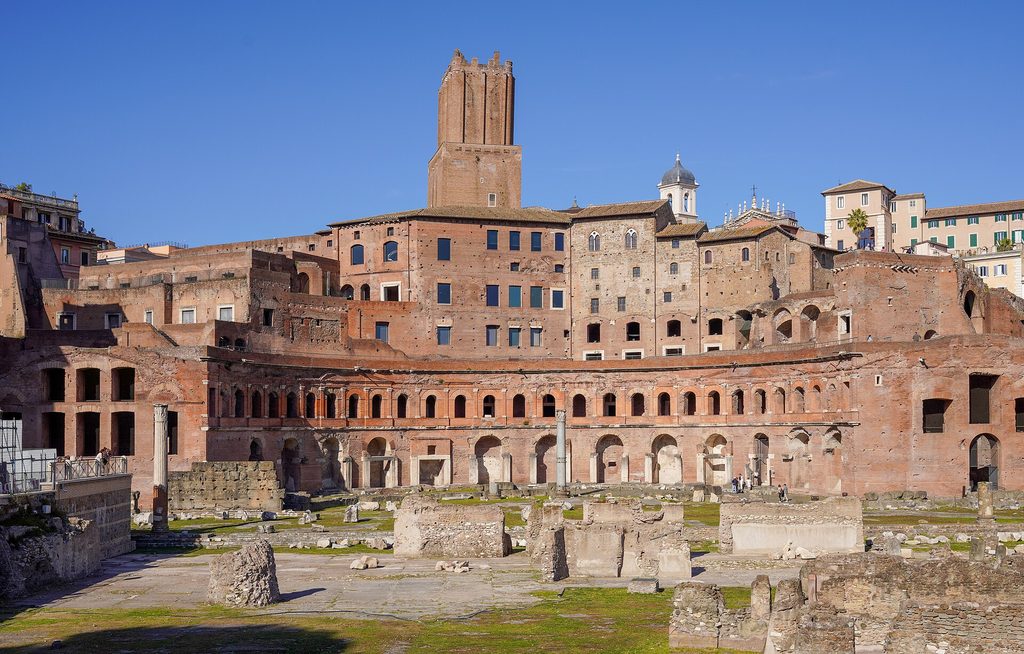
(Mercato di Traian)
The market place was originally built between 100-110 AD. It was the equivalent of the Arndale Centre for Romans. It was built out of brick and cement, a relatively cheap building material, but one that would withstand the rigors of use and time. The market comprised 150 small shops and apartments, later warehouses added and finally the offices of the imperial administration. This brought together businesses and administration into a central business district. It is a monumental building rising up over several floors and was built in a semi-circular shape, which faces towards the Forum.
Just like today’s modern shopping complexes the market had different businesses located on different floors. On the first three floors were the Tabernae (Shops): these were individual barrel roofed brick rooms with completely open fronts which opened out onto a wide street. Each floor was dedicated to selling a particular type of product. The ground floor was grain and fresh horticultural produce. The first floor was oil and wine. The second and third floors spices that were imported from all over the Roman Empire and from further afield in Asia and Africa. The third and fourth floors were taverns and street food stalls. Then finally the fifth and sixth floors were the administrative offices and apartments
The market would have been heaving with people, the air filled with chatter and bartering. Now imagine the smells from the spices, the cooked food, the alcohol and fresh produce. The colours would have been rich from the fresh fruit and vegetables, the array of spices and the mix of the population which would have had different skin tones, different fabrics and jewellery. It was certainly an area that would have engulfed all of your senses.
The market was first re-discovered in 1924 and took nearly ten years to fully uncover, but restoration progress was halted by the second world and it wasn’t until 2005 that the groundbreaking restoration and conservation work was commenced which was completed in 2007.
In the Autumn of 2007 the Museum of the Imperial Fora opened, which still today showcases the architectural and decorative techniques used to build the Forum and Marketplace. The museum uses standard information panels with modern technology to bring the architecture to life so the visitor is transported back to Imperial Rome